Essays and Reflections
Book Details
• Publisher: Bharatiya Vidya Bhavan
• Language: English
• Published Year: 1964
• Pages: 194
• Dimensions: 19 x 12 cm
• ISBN: Not Available
• Book Condition: Used – Good
• Condition Note: Book is in good condition, but pages are yellowish in color
• Availability: In Stock
About the Book
The Philosophy of Vivekananda by R. D. Ranade delves into the life and philosophical ideas of Swami Vivekananda, one of India’s most influential spiritual leaders. The book provides a comprehensive analysis of Vivekananda’s teachings, focusing on his contributions to the understanding of Hindu philosophy, spirituality, and nationalism.
Ranade explores Vivekananda’s interpretation of Vedanta, his emphasis on the unity of all religions, and his advocacy for social reform. The work highlights Vivekananda’s vision of a harmonious society, which balances individual spiritual growth with collective social responsibility.
The author also examines Vivekananda’s speeches and writings, especially his historic address at the Parliament of Religions in Chicago in 1893, which introduced the teachings of Vedanta to the Western world. Through this, the book underscores Vivekananda’s role in reviving Indian spirituality and his influence on the global perception of Hinduism.
The Philosophy of Vivekananda serves as a valuable resource for readers interested in Indian philosophy, spiritual thought, and the legacy of one of the key figures of modern India.
Product Information
Product Information
Shipping & Returns
Shipping & Returns
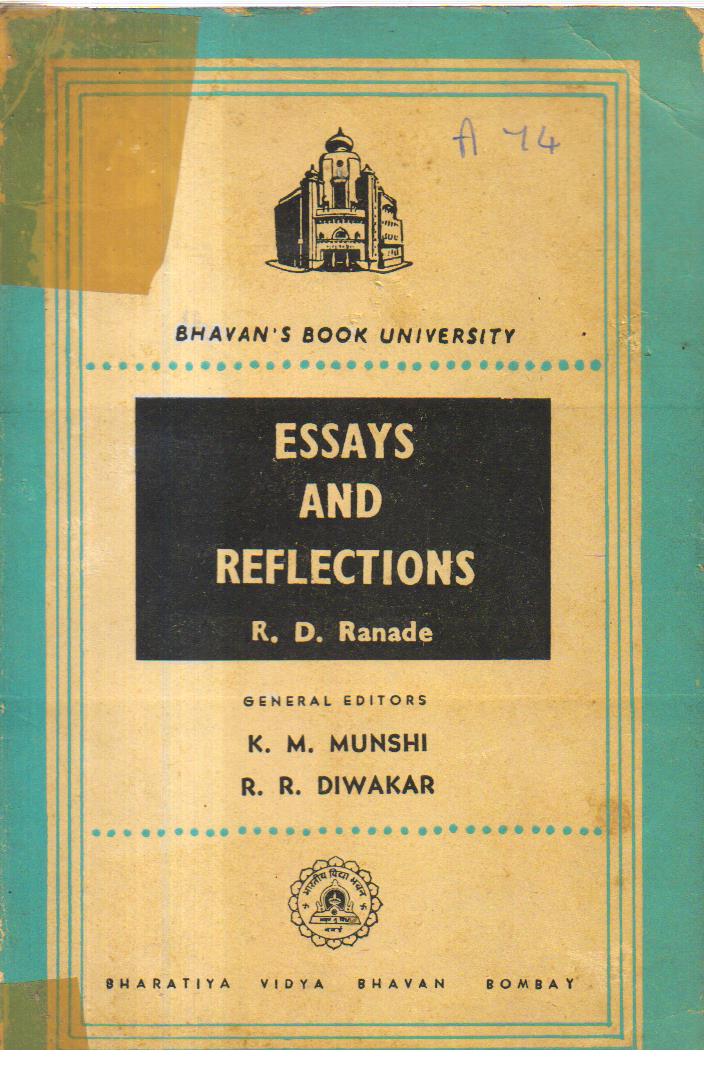
Essays and Reflections
Essays and Reflections
Book Details
• Publisher: Bharatiya Vidya Bhavan
• Language: English
• Published Year: 1964
• Pages: 194
• Dimensions: 19 x 12 cm
• ISBN: Not Available
• Book Condition: Used – Good
• Condition Note: Book is in good condition, but pages are yellowish in color
• Availability: In Stock
About the Book
The Philosophy of Vivekananda by R. D. Ranade delves into the life and philosophical ideas of Swami Vivekananda, one of India’s most influential spiritual leaders. The book provides a comprehensive analysis of Vivekananda’s teachings, focusing on his contributions to the understanding of Hindu philosophy, spirituality, and nationalism.
Ranade explores Vivekananda’s interpretation of Vedanta, his emphasis on the unity of all religions, and his advocacy for social reform. The work highlights Vivekananda’s vision of a harmonious society, which balances individual spiritual growth with collective social responsibility.
The author also examines Vivekananda’s speeches and writings, especially his historic address at the Parliament of Religions in Chicago in 1893, which introduced the teachings of Vedanta to the Western world. Through this, the book underscores Vivekananda’s role in reviving Indian spirituality and his influence on the global perception of Hinduism.
The Philosophy of Vivekananda serves as a valuable resource for readers interested in Indian philosophy, spiritual thought, and the legacy of one of the key figures of modern India.
Original: $3.73
-70%$3.73
$1.12Product Information
Product Information
Shipping & Returns
Shipping & Returns
Description
Book Details
• Publisher: Bharatiya Vidya Bhavan
• Language: English
• Published Year: 1964
• Pages: 194
• Dimensions: 19 x 12 cm
• ISBN: Not Available
• Book Condition: Used – Good
• Condition Note: Book is in good condition, but pages are yellowish in color
• Availability: In Stock
About the Book
The Philosophy of Vivekananda by R. D. Ranade delves into the life and philosophical ideas of Swami Vivekananda, one of India’s most influential spiritual leaders. The book provides a comprehensive analysis of Vivekananda’s teachings, focusing on his contributions to the understanding of Hindu philosophy, spirituality, and nationalism.
Ranade explores Vivekananda’s interpretation of Vedanta, his emphasis on the unity of all religions, and his advocacy for social reform. The work highlights Vivekananda’s vision of a harmonious society, which balances individual spiritual growth with collective social responsibility.
The author also examines Vivekananda’s speeches and writings, especially his historic address at the Parliament of Religions in Chicago in 1893, which introduced the teachings of Vedanta to the Western world. Through this, the book underscores Vivekananda’s role in reviving Indian spirituality and his influence on the global perception of Hinduism.
The Philosophy of Vivekananda serves as a valuable resource for readers interested in Indian philosophy, spiritual thought, and the legacy of one of the key figures of modern India.