PABNA DISTURBANCES AND THE POLITICS OF RENT
Book Details
-
Author: Kalyan Kumar Sen Gupta
-
Edition: August 1974
-
Multiple Book Set: No
About the Book
Kalyan Kumar Sen Gupta’s work examines the significant event in the late 19th-century socio-economic history of Bengal—the uprising of ryots in Pabna in 1873 against the permanently settled landlords. Led by a powerful and organized agrarian league, this movement sparked similar uprisings in other parts of eastern and central Bengal (now Bangladesh). These movements, inspired by the Pabna model, gradually became widespread protests against the exploitative forms of landlordism that were prevalent in the cash crop-producing areas of Bengal during the colonial era.
The book delves into the transformation of landlord-tenant relationships and how these uprisings highlighted a shift towards 'high landlordism,' a term used by Sen Gupta to describe the increasing concentration of power among landlords. This phenomenon mirrored the development of the bourgeoisie class, where certain sections of the ruling class gained sufficient control over capital to dictate terms to the working class. Similarly, the high landlords in Bengal exhibited similar behavior towards the peasantry.
Sen Gupta argues that these practices in Pabna set the stage for the peasant movements in Bangladesh, outlining a key phase in the development of landlordism and its impact on the rural economy and the peasantry in the late 19th century. The book provides a detailed analysis of these socio-economic changes and the role of peasant uprisings in challenging the dominance of landlords.
Product Information
Product Information
Shipping & Returns
Shipping & Returns
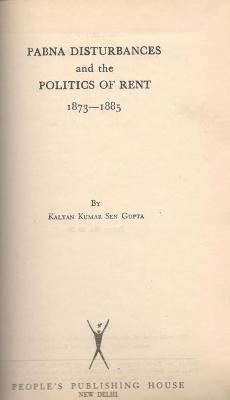
PABNA DISTURBANCES AND THE POLITICS OF RENT
PABNA DISTURBANCES AND THE POLITICS OF RENT
Book Details
-
Author: Kalyan Kumar Sen Gupta
-
Edition: August 1974
-
Multiple Book Set: No
About the Book
Kalyan Kumar Sen Gupta’s work examines the significant event in the late 19th-century socio-economic history of Bengal—the uprising of ryots in Pabna in 1873 against the permanently settled landlords. Led by a powerful and organized agrarian league, this movement sparked similar uprisings in other parts of eastern and central Bengal (now Bangladesh). These movements, inspired by the Pabna model, gradually became widespread protests against the exploitative forms of landlordism that were prevalent in the cash crop-producing areas of Bengal during the colonial era.
The book delves into the transformation of landlord-tenant relationships and how these uprisings highlighted a shift towards 'high landlordism,' a term used by Sen Gupta to describe the increasing concentration of power among landlords. This phenomenon mirrored the development of the bourgeoisie class, where certain sections of the ruling class gained sufficient control over capital to dictate terms to the working class. Similarly, the high landlords in Bengal exhibited similar behavior towards the peasantry.
Sen Gupta argues that these practices in Pabna set the stage for the peasant movements in Bangladesh, outlining a key phase in the development of landlordism and its impact on the rural economy and the peasantry in the late 19th century. The book provides a detailed analysis of these socio-economic changes and the role of peasant uprisings in challenging the dominance of landlords.
Product Information
Product Information
Shipping & Returns
Shipping & Returns
Description
Book Details
-
Author: Kalyan Kumar Sen Gupta
-
Edition: August 1974
-
Multiple Book Set: No
About the Book
Kalyan Kumar Sen Gupta’s work examines the significant event in the late 19th-century socio-economic history of Bengal—the uprising of ryots in Pabna in 1873 against the permanently settled landlords. Led by a powerful and organized agrarian league, this movement sparked similar uprisings in other parts of eastern and central Bengal (now Bangladesh). These movements, inspired by the Pabna model, gradually became widespread protests against the exploitative forms of landlordism that were prevalent in the cash crop-producing areas of Bengal during the colonial era.
The book delves into the transformation of landlord-tenant relationships and how these uprisings highlighted a shift towards 'high landlordism,' a term used by Sen Gupta to describe the increasing concentration of power among landlords. This phenomenon mirrored the development of the bourgeoisie class, where certain sections of the ruling class gained sufficient control over capital to dictate terms to the working class. Similarly, the high landlords in Bengal exhibited similar behavior towards the peasantry.
Sen Gupta argues that these practices in Pabna set the stage for the peasant movements in Bangladesh, outlining a key phase in the development of landlordism and its impact on the rural economy and the peasantry in the late 19th century. The book provides a detailed analysis of these socio-economic changes and the role of peasant uprisings in challenging the dominance of landlords.